
Our Origin
From a Hawaiian cane grass field to the Appalachian Mountains.
The Cane Grass Field
Don Garcia isn't just my given name. It is a hat I wear; a persona entirely dedicated to the philosophy of roasting.
It was 1991 in Haleiwa, Hawaii. Having recently returned from Ph.D. research in Taiwan, I didn't even drink coffee—I was spending more than half my income on tea. At the time, I had been invited by my classmate Tom Starchild (who was famously thrown out of the UH Philosophy department for submitting his Master's Thesis on an old cassette) to live rent-free in a field of 10-foot-high cane grass, so long as I kept him abreast of our classes' daily discussions.
One day, I was minding my own business smashing up some half-year-old macadamia nut coffee beans in a blue bandana with a rock, intending to steep the grinds in my small teapot. Tom asked what I was doing. "Making coffee," I said. "STOP! Don't drink it!" he yelled. I had just thrown the I Ching (Book of Changes) and received the hexagram for Corner of the Mouth. The judgment read: "The sage is mindful of what he eats." Tom was so adamant that I put my implements away and walked into the Coffee Gallery for the very first time.
The Apprentice
The young owner saw me and invited me back. They had just purchased a coffee roaster and were waiting on delivery. Unfortunately, the person who went to 'roasting school' to learn how to operate it was her husband—and during the six months the roaster was being built, they had divorced. With my cooling espresso still undrunk, I walked back to the field having agreed to start work the next day.
I had been practicing Tai-Chi for five years in Hawaii, and another five years in the Republic of China (Taiwan) before I ever touched a roaster. Every Tai-Chi practitioner knows that with practice, the sense faculties become settled and clear. So, when I began roasting, my method was based entirely on paying attention.
I had the rare privilege of learning from absolute industry legends. I was mentored by the head roaster of Lion Coffee, who went on to become one of Starbucks' original five roastmasters. We roasted alongside Steve Diedrich and Gary Talboy. Over two years, we became exceptional at roasting, blending, and stocking all varieties of pure Kona coffees.
Zen and Alfred Peet
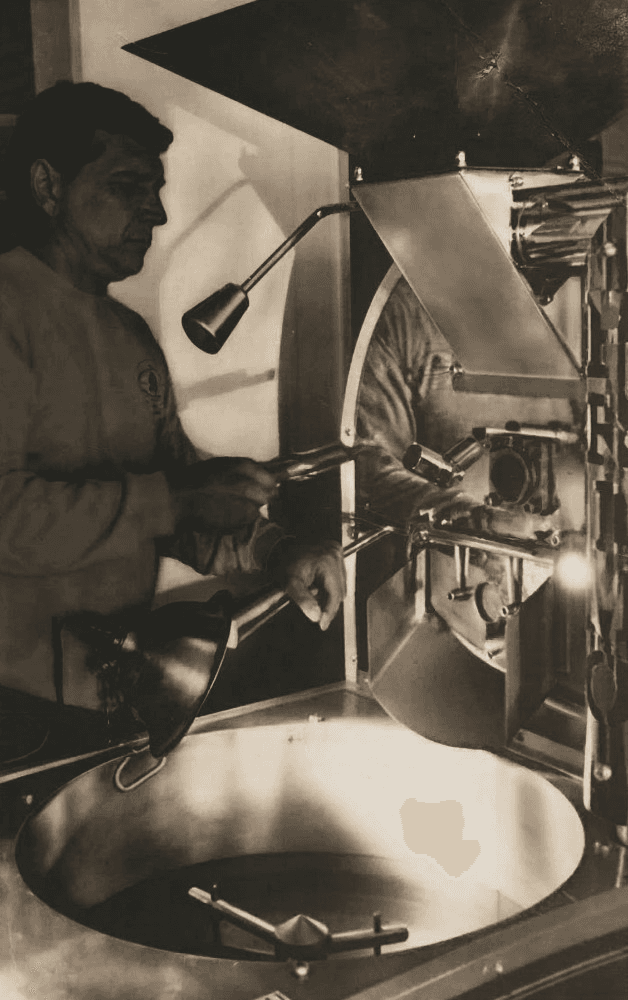
I had first met Alfred Peet in 1991. He was President of the Specialty Coffee Association of America and was in town to judge the Kona Coffee Cupping Contest. He had let me roast a few batches on the sample roasters in the back room of Kona Kai coffees.
About a month later, I was roasting in Haleiwa when I noticed someone watching me from behind. It was Alfred. I asked him to 'take the machine', but he declined, citing retirement. I invited him outside for a cup of coffee and a slice of Dutch-apple pie with vanilla ice cream.
We sat at my table making small talk when he noticed a stack of books. "That’s my favorite book of all time!" he said, pointing. I told him I was writing my Ph.D. dissertation on it. As the editorial assistant for the Journal of Chinese Philosophy, I suggested he write a paper on Zen and coffee roasting. He said he was weary about having his ideas stagnated in print. But I pressed, poked, prodded, and persisted.
Right then, I cleaned the machine. We had at least 15 different types and grades of pure Kona coffees. Alternately, we roasted every single one. Then, together, we cupped every one. That afternoon with Alfred was the exact moment I truly began to understand the process of the bean’s development and how to influence its natural characteristics.
The Aesthetic Roast
I registered the concept of the "Aesthetic Roast" in Hawaii. It is based on early Buddhist epistemology—the understanding that the bean develops empirically. It needs to be dripping with a value for 'good.'
We don't grow the beans, but we take absolute responsibility for their quality in your cup. The real value of coffee is its use as a tool to fulfill one's own-nature. Good, fresh coffee equals good, fresh ideas. The means are never separated from the goal.
It doesn't take an expert to discern really good coffee. All that is required is a tongue. The whole thing is a form of entertainment, highly ironic, suggestive, and perhaps highlighting the mystical. As soon as you taste a sip of aesthetically roasted, proper coffee, you will be suddenly transported—Home.